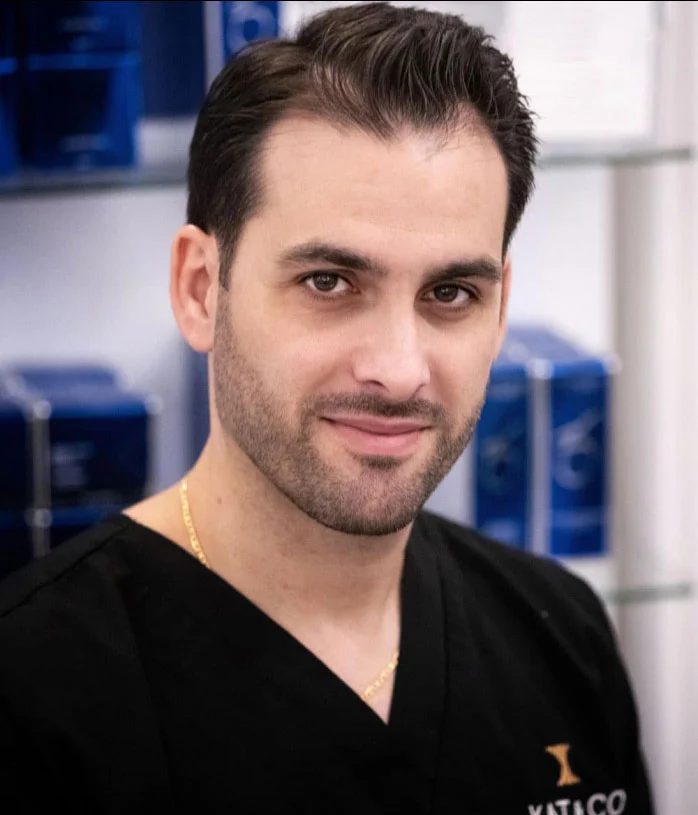
Patient guide to body surgery with Mr Andrej Salibi
Patient update | 14 November 2026
Author: Annabelle Baugh
If you’re considering body surgery, start with what you’d like to change. You might want to address loose skin after weight loss, reshape an area with localised fat or relieve discomfort from an abdominal skin fold. At your consultation, Mr Salibi can assess your skin and underlying tissue, review your medical history and previous surgery, and explain which options he offers and which may suit you.
Tummy tuck (abdominoplasty)
A tummy tuck removes excess skin and some fat from the abdomen. Where appropriate, the surgeon can also tighten the abdominal wall if the muscles have separated.
- Mini tummy tuck. Treats a limited amount of loose skin below the belly button.
- Full tummy tuck. Addresses more extensive loose skin across the abdomen. It usually involves bringing the belly button through a new opening in the skin and may include tightening the abdominal wall.
- Extended tummy tuck. Extends the incision towards the hips to remove loose skin that continues beyond the front of the abdomen.
Liposuction can sometimes be combined with a tummy tuck to reshape areas such as the waist or flanks. Ask where your scar would sit and how far it would extend.
LIPOSUCTION OPTIONS
Liposuction reshapes specific areas by removing localised fat through a thin suction tube called a cannula. It is a body-contouring procedure. If loose skin is your main concern, ask whether skin removal would better address it.
- VASER liposuction: VASER is an ultrasound-assisted liposuction technique. The surgeon uses ultrasound energy to loosen fat before removing it with a suction cannula. Ask what using ultrasound would add in your case, what risks it carries and how your skin is likely to respond after the fat is removed.
- SAFELipo: Three steps used to remove fat and refine the contour.
- Separation. The surgeon uses a specialised cannula to loosen fat before suction.
- Aspiration. The loosened fat is removed using suction.
- Fat equalisation. The surgeon redistributes some of the fat left beneath the skin to help smooth the transition between treated and untreated areas.
This technique can be used for circumferential liposuction, where treatment extends around an area such as the waist or thighs. Ask what can realistically be treated in one operation and about risks such as bruising, swelling, changes in sensation and uneven contours.
Thigh lift (thighplasty)
A thigh lift removes loose skin and reshapes the thighs. The amount and location of the loose skin determine how far the incision needs to extend.
- Mini or short-scar inner thigh lift. Treats a limited area near the groin, where the scar may sit in the groin crease.
- Vertical inner thigh lift. Treats loose skin extending farther down the thigh and leaves a scar along the inner thigh.
- Outer thigh lift. Addresses loose skin around the outer thighs and hips. It may form part of a lower body lift.
Liposuction may be combined with skin removal when localised fat also affects the contour.
Arm lift (brachioplasty)
An arm lift removes loose skin from the upper arms. The scar length depends on how much skin needs to be removed and where it sits.
- Mini arm lift. Treats a small area of loose skin close to the armpit.
- Full arm lift. Treats loose skin along the upper arm, usually leaving a scar that runs from the armpit towards the elbow.
- Extended arm lift. Extends the incision towards the side of the chest when loose skin continues beyond the upper arm.
Liposuction may also be used to address localised fat.
 Buttock lift and fat transfer (BBL)
Surgical buttock lift
A surgical buttock lift removes excess skin and lifts the remaining tissue to reshape the buttocks. It may be considered after significant weight loss and can be performed on its own or as part of a lower body lift.
Buttock fat transfer (Brazilian butt lift or BBL)
Buttock fat transfer adds volume. Fat is removed by liposuction from areas such as the abdomen, flanks or thighs, prepared and injected into the buttocks. Superficial gluteal lipofilling (SGL) places the fat in the layer beneath the skin and above the muscle.
The British Association of Aesthetic Plastic Surgeons (BAAPS) recommends real-time ultrasound during injection to check where the fat is being placed. Buttock fat transfer carries a risk of fat embolism, which can be life-threatening. If you’re considering it, ask the surgeon about their training, how they use ultrasound and what emergency care is available at the facility.
Back lift
A back lift removes loose skin to reshape the upper or lower back. An upper back lift is sometimes called a bra-line lift because the scar may sit around the bra line. A lower back lift addresses loose skin around the lower back and waist and may form part of a lower body lift.
Body lift
A body lift reshapes several areas in one surgical plan, often after significant weight loss.
- Lower body lift. Can address loose skin around the abdomen, hips, outer thighs and buttocks.
- Upper body lift. Can address excess skin around the upper back, sides of the chest and nearby areas.
- Circumferential body lift. Sometimes called a belt lipectomy or 360° tummy tuck, it removes excess skin around the waist, including the abdomen, flanks and lower back. The terms can describe overlapping operations, so ask exactly which areas your surgeon plans to treat and where the scars would sit.
More extensive surgery may be carried out in stages. Ask how the size of the operation would affect recovery and the support you’ll need at home.
Panniculectomy (abdominal apron removal)
A panniculectomy removes an overhanging fold of skin and fat from the lower abdomen. The operation focuses on removing the fold. A tummy tuck may also reshape the wider abdomen and tighten the abdominal wall. Panniculectomy may be considered if the fold causes discomfort, makes hygiene difficult or leads to repeated skin irritation.
Labiaplasty (labia reduction and reshaping)
Labiaplasty usually involves reducing or reshaping the labia minora, the inner folds of the vulva. Labia naturally vary in size, shape and symmetry. During your consultation, you can discuss any discomfort or other concerns and what a procedure might realistically achieve.
- Trim technique. Removes tissue along the edge of the inner labia.
- Wedge technique. Removes a section of tissue while keeping much of the original edge.
- Other procedures. Depending on your concerns, the surgeon may discuss reducing excess tissue in the outer labia, addressing asymmetry or assessing a problem after previous surgery.
Ask about scarring, wound healing, changes in sensation and how long you’ll need to avoid activities that put pressure on the area.
Renuvion (J-Plasma) Skin Tightening
Renuvion uses radiofrequency energy and helium plasma to heat tissue beneath the skin. It may be discussed alongside liposuction in selected cases. Ask which device and handpiece would be used, what improvement you could expect and how much loose skin would remain. Possible complications include burns and injury to nearby tissue.
Questions to ask at your body surgery consultation
- Which procedure would address my concerns, and what changes can I realistically expect?
- How could my health, weight, medications or previous operations affect my suitability and risks?
- Where will the scars sit, how long might they be and how are they likely to change over time?
- What are the main risks for the procedure you recommend? Ask about wound-healing problems, infection, fluid collections (seromas), blood clots and changes in sensation.
- Can my procedures be combined, or would you advise having them in stages?
- Will I need drains, compression garments or help at home?
- When can I return to work, driving, exercise and lifting?
- How could weight changes or ageing affect the result?
- What anesthestic do you recommend and where will my surgery take place?
- If I require a transfer for overnight care which hospital will I be in and will I get a private, ensuite room?
- What aftercare is included, who should I contact outside clinic hours and what costs could apply if I need further treatment?
OYL tip. If you’re considering surgery after significant weight loss, ask how long your weight should be stable and what practical support you’ll need during recovery.
Discuss your body surgery options with Mr Salibi
At your consultation, Mr Salibi can explain which procedures he offers, what changes are realistic for you and how the options compare in terms of risks, scarring and recovery.
Considering body surgery?
Make an enquiry to arrange a consultation and discuss your options.
Mr ANDREJ SALIBI’s Full Profile
Sources and Medical References
The information in this article is based on trusted medical research and reputable health
sources. It’s meant to help you better understand your health but shouldn’t replace advice from your doctor or healthcare team. You can find the sources we used listed below, with links if you’d like to read more.
- Tummy tuck (abdominoplasty). Explains the difference between partial and full abdominoplasty, what recovery involves and possible complications. NHS guide to tummy tuck surgery.
- Liposuction. Covers how fat is removed, what the procedure can achieve and what to expect during recovery. NHS guide to liposuction
- Surgical fat transfer. Explains how fat is collected and transferred, including the specific risks of transferring fat to the buttocks. NHS guide to surgical fat transfer. NHS
- Labiaplasty. Covers natural variation in the labia, what surgery involves, recovery and possible complications. NHS guide to labiaplasty
- Arm lifts, thigh lifts and body lifts. These patient guides describe the areas treated, typical incision locations and recovery considerations. ASPS arm lift guide · ISAPS thigh lift guide · ASPS body lift guide. American Society of Plastic Surgeons
- Panniculectomy (abdominal apron removal). Explains what the operation removes and how it differs from a tummy tuck. American Society of Plastic Surgeons guide to panniculectomy. American Society of Plastic Surgeons
- Buttock fat transfer (BBL or superficial gluteal lipofilling). The British Association of Aesthetic Plastic Surgeons reviews the risks and recommends using real-time ultrasound to guide fat placement above the muscle. BAAPS safety review and recommendations.
- VASER and SAFELipo. A published trial compares VASER-assisted liposuction with suction-assisted liposuction. A separate paper describes the three steps of SAFELipo. VASER clinical trial · Published description of SAFELipo.
- Renuvion (J-Plasma). The US Food and Drug Administration explains the uses it has cleared for specific handpieces and provides device safety information. FDA safety communication on Renuvion and J-Plasma.